
At our private orthopaedic practice in Gescher, we therefore look beyond just the site of the pain. We want to know when the symptoms occur, which movements make them worse, whether the knee swells, and how the hip, leg alignment, foot and muscles interact. Only when all this information fits together can we make an informed decision about what the knee actually needs.
Knee pain in Gescher: What could be causing it?
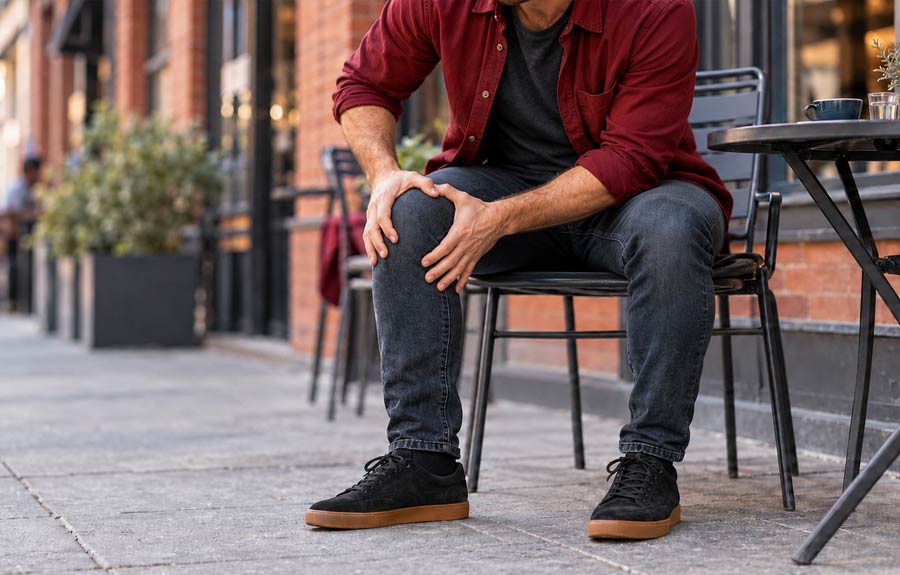
Key points at a glance
- Knee pain can have many possible causes. The location of the pain alone is not sufficient to make a diagnosis.
- Pain when climbing stairs can, amongst other things, originate from the area around the kneecap; in the case of osteoarthritis, the inner or outer side of the knee may also be affected.
- A crunching or cracking sound without pain is not automatically a sign of damage requiring treatment.
- A noticeably swollen knee (‘water on the knee’) is a symptom – the cause must be investigated.
- For many knee problems, tailored exercise is beneficial. Conversely, prolonged rest weakens the muscles and reduces the knee’s ability to cope with stress.
Following an accident, if the knee is locked, if there is obvious instability, if the joint is hot and red, or if you have a fever, you should have your knee examined by a doctor as soon as possible.
1. The most important question: When does the knee hurt?
A knee can hurt in many different ways. It is therefore important for us not only to know where the pain is located, but above all in what situations it occurs. A knee that only hurts when climbing stairs tells a different story to a knee that hurts at night whilst at rest or swells up after every walk.
The following observations, for example, are helpful:
- Does the pain start when you begin walking and ease after a few steps?
- Does the knee hurt when bending, climbing stairs or standing up from a chair?
- Is the pain more on the inside, outside, front or back of the knee?
- Is the knee stiff in the morning?
- Does it swell after exertion?
- Was there an accident, a twist or a new sporting activity?
- Does the knee feel unstable or does it lock up from time to time?
This information is no substitute for a medical examination. However, it helps to narrow down the possible causes and plan further diagnostic tests more effectively.
2. Knee pain when climbing stairs
Climbing stairs places greater demands on the knee than walking on level ground. When going up – and particularly when going down – greater forces act on the joint and the kneecap. This is why symptoms often become noticeable sooner here than during normal everyday activities.
Pain when climbing stairs may, for example, originate from the area behind the kneecap. Early-stage or advanced knee osteoarthritis may also become apparent under this strain. With knee osteoarthritis, pain occurs, amongst other things, when standing up and climbing stairs, if the area beneath the kneecap is affected. At the same time, however, muscles, tendons, leg alignment or movement patterns may also play a role.
Our clinical experience shows that it is not enough simply to examine the knee whilst the patient is sitting. Particularly with load-dependent symptoms, it is important to observe how the leg is moved – in other words, how the hip, knee and foot work together.
3. Pain on the inside or outside of the knee
Many patients are able to localise their pain with surprising accuracy: ‘right on the inside of the knee’ or ‘more on the outside’. This is helpful for diagnosis, but not conclusive.
On the inner side, for example, the joint surfaces, meniscus, ligaments or tendon insertions may cause discomfort. On the outer side, in turn, other structures may be involved. In the case of knee osteoarthritis, the side where the pain is felt may also depend on which part of the joint is more severely affected.
It is therefore important to consider the combination of the location of the pain and the situation: Does it hurt when turning the knee? When walking for long periods? When bending deeply? After exercise? Is there any swelling as well? Only by combining this information can a meaningful overall picture be formed.
4. Crunching and cracking in the knee: is this a sign of wear and tear?
A knee that cracks or grinds can quickly cause concern. However, noises alone say little about how healthy or unwell the joint is. Even a pain-free knee can make noises.
The creaking becomes particularly relevant when it is accompanied by pain, swelling, instability or increasing restricted movement. In such cases, it should be investigated whether, for example, the kneecap is misaligned, there is excessive strain, or there are changes within the joint.
Important: A noise is not an X-ray finding. And an X-ray finding does not in itself explain every instance of pain. Both must fit the clinical picture.
5. Fluid in the knee: What does swelling mean?
If the knee becomes noticeably thicker, feels tight or can no longer be bent fully, fluid may have accumulated in the joint. Colloquially, people say: ‘I’ve got water on my knee.’
Joint effusion is not a diagnosis in its own right. It indicates that the knee is reacting to something. Possible causes include overuse, osteoarthritis, an injury or inflammation. How urgently a diagnosis needs to be made depends on the course of the condition and any additional symptoms.
A severely swollen, hot or reddened knee – particularly when accompanied by a fever or a marked feeling of being unwell – should be assessed by a doctor as soon as possible. Even following an acute injury, significant swelling is a reason not to simply carry on training.
6. How can you recognise knee osteoarthritis?
Knee osteoarthritis often begins gradually. Initially, pain on weight-bearing is typical. Later, the symptoms may become more frequent, the joint may feel stiff, and pain may also occur at rest or at night. Some people experience symptoms mainly in the mornings or in the evenings.
Another sign may be what is known as ‘start-up pain’: the first few steps are difficult, but the pain eases after a bit of movement. Range of motion may also gradually decrease.
Nevertheless, it is important to note that not every episode of knee pain from middle age onwards is automatically osteoarthritis. Furthermore, the severity indicated by an X-ray does not always correspond to the intensity of the pain experienced.
When it comes to treatment, therefore, what really matters is what actually limits you in your day-to-day life: how far can you walk? Can you use the stairs? Is exercise possible? How does your knee feel the next day? It is precisely these factors that determine realistic treatment goals.
7. What can you do yourself – and what is best avoided?
What is often advisable
- Temporarily adjust the level of activity, rather than completely resting the knee for weeks on end.
- Observe which movements trigger pain and whether the knee swells afterwards.
- If symptoms have persisted for some time, build up strength and improve the quality of movement in a targeted manner – ideally tailored to the findings.
- In cases of knee osteoarthritis, it is generally important to keep moving. Regular exercise and strength training are key conservative measures.
- If you are overweight, losing weight can reduce the mechanical strain on the knee joint.
What is generally not a good idea
- Trying to ‘train the pain away’ in the long term, even though it is getting worse week by week.
- Complete rest for weeks on end without a medical reason.
- Using an MRI or X-ray scan on its own to make a diagnosis without a clinical examination.
- Always just applying cold packs for recurring swelling without having the cause investigated.
- Treating injections, bandages or insoles as a one-size-fits-all solution – they can be useful, but must be appropriate for the diagnosis.
8. How we investigate knee pain in Gescher
In our private practice in Gescher, the diagnostic process begins by asking what the knee can no longer do in everyday life. This is followed by an orthopaedic examination and – depending on the symptoms – functional tests.
Among other things, we look for:
- Range of motion and pain on flexion and extension
- Swelling and tenderness
- Stability of ligaments and the joint
- Signs of meniscus- or patella-related problems
- Muscle strength and differences between sides
- Leg alignment and movement pattern
- Interaction between the hip, knee and foot
Any
existing X-ray or MRI scans can, of course, be taken into account. New imaging is not automatically required. It should address a specific issue arising from the patient’s symptoms and the examination.
In cases of abnormal movement patterns, a postural and movement analysis may also be useful. The practice utilises, amongst other things, 4D analysis as well as gait and standing analyses. What matters is not the technique itself, but whether it offers diagnostic added value for the specific issue at hand.
9. What treatments might be considered?
Treatment depends on the cause. An irritated tendon insertion requires a different approach to advanced osteoarthritis. An unstable knee following an injury, in turn, requires a different approach to load-dependent pain without structural damage.
The treatment approach at Dr Beate Helgers’ private practice in Gescher therefore operates on three interlinked levels:
1. Reducing pain and irritation
If pain makes movement almost impossible, the initial focus may be on providing acute relief. Depending on the diagnosis, options may include, for example, medication, bandages, manual therapy or targeted injections. In the case of knee osteoarthritis, cortisone injections can provide short-term relief; however, they are not a long-term treatment and must be assessed on a case-by-case basis.
2. Improving function
Muscles, tendons, fasciae and movement patterns influence how weight is distributed on the knee. That is why we do not just treat the joint itself, but also assess the structures that move and stabilise it. Depending on the findings, manual or physical therapy techniques may form part of the treatment plan.
3. Building resilience
In the long term, it is often crucial that the knee regains its ability to bear weight. Strength, coordination and optimal movement patterns can be trained. To this end, the practice in Gescher offers, amongst other things, medical exercise therapy and personalised training programmes.
The aim is not to ‘get rid of’ every change in the knee. The realistic aim is to reduce pain, improve function and make everyday life as reliable as possible again.
10. When should the knee be examined promptly?
Not all knee pain is an emergency. However, some situations should be assessed by a doctor promptly:
- significant swelling following an accident or a twisting injury
- the knee can no longer be fully straightened or feels locked
- severe instability or the knee buckling
- It is difficult or impossible to put weight on the knee
- visible misalignment following an injury
- A severely red, hot and swollen knee
- Fever or a distinct feeling of being unwell, accompanied by joint pain
Get your knee pain checked out in Gescher
If you experience recurring knee problems, find it difficult to climb stairs, or if the joint keeps swelling up, a targeted orthopaedic examination may be advisable.
Private orthopaedic practice in Gescher
, Marktplatz 2–4, 48712 Gescher
11. Frequently asked questions about knee pain
Do you always need an MRI scan if you have knee pain?
No. A consultation and physical examination often provide important clues in themselves. An MRI scan is particularly useful when it is intended to answer a specific diagnostic question – for example, where certain soft-tissue or meniscus injuries are suspected, or when symptoms remain unclear despite treatment.
What sort of shoes are best for knee pain?
There is no such thing as a ‘knee pain shoe’ in general. The key factors are foot shape, gait, type of sport and individual strain. Shoes that are badly worn or unsuitable can contribute to discomfort. In the case of recurring problems, it may be worth assessing the alignment of the foot and leg as well.
Is a cracking sound in the knee dangerous when playing sport?
Noises that are not accompanied by pain, swelling or instability are often nothing to worry about. If the cracking sound is new and occurs alongside symptoms, it should be investigated further.
Can I carry on doing sport if I have osteoarthritis of the knee?
In many cases, yes – and regular exercise is actually a key part of the treatment. Endurance and strength training that are gentle on the joints are often suitable. The key factors are the level of exertion, the pain response and individual function.
Can I cycle if I have knee pain?
That depends on the cause and the pain response. Cycling puts a different strain on the knee to running and is well tolerated by some people with certain conditions. If the knee becomes noticeably painful or swollen during or after cycling, the level of exertion should be adjusted and the cause investigated.
Can a meniscus cause symptoms even without an accident?
Yes. Menisci can change over time and cause symptoms even without acute trauma. At the same time, meniscal changes visible on an MRI scan are not automatically the cause of pain. The scan results and the clinical examination must be consistent with one another.
When is a knee brace advisable?
A support bandage can provide temporary relief or a sense of security for certain conditions. However, it is no substitute for a diagnosis or targeted muscle-building exercises. Whether a support bandage is appropriate, and if so which one, depends on the findings.
Can the knee still hurt even if there is little visible on the X-ray?
Yes. Pain can also arise from tendons, muscles, fascia, the patellar track or functional stress patterns. Conversely, there may be clear signs of wear and tear visible on an X-ray without the person experiencing severe pain.

About the author
Dr Beate Helgers, MD – Specialist in Orthopaedics
Dr Beate Helgers studied medicine at Ruhr University Bochum. Her medical training took her, amongst other places, to the University Orthopaedic Clinic at St Josef’s Hospital in Bochum, the Department of General and Trauma Surgery at Marienkrankenhaus Schwerte, the University Orthopaedic Clinic at RWTH Aachen University, and the Paracelsus Clinic in Marl.
In 1996, she obtained her PhD in orthopaedics, and in 1998 she was recognised as a specialist in orthopaedics. In 2011, she established her own private practice in Dorsten-Lembeck; since 2020, she has also had a branch in Ahaus. Today, Steinfurt and Gescher are also part of the practice network.
Her treatment approach combines orthopaedic diagnostics and pain management with an analysis of functional relationships and – where medically appropriate – active stabilisation and exercise therapy.
Knee pain? Let’s take a closer look.
Whether it’s when climbing stairs, after exercise or for no apparent reason: recurring knee pain should not just be temporarily relieved, but properly assessed.
Orthopaedics Gescher
, Marktplatz 2–4 · 48712 Gescher
Sources and further information
- AWMF: S3 Guideline on the Prevention and Treatment of Knee Osteoarthritis (2025)
- Gesundheitsinformation.de: Knee osteoarthritis (gonarthrosis)
- Gesundheitsinformation.de: What helps with pain at the front of the knee?
- Dr Beate Helgers’ private practice: Treatment approach
- Dr Beate Helgers’ private practice: Dr Beate Helgers’ CV